From Idea to AI Product: Real Timeline, Cost & Pitfalls (India Edition)
 Subham Agrawal8 April 20269 min read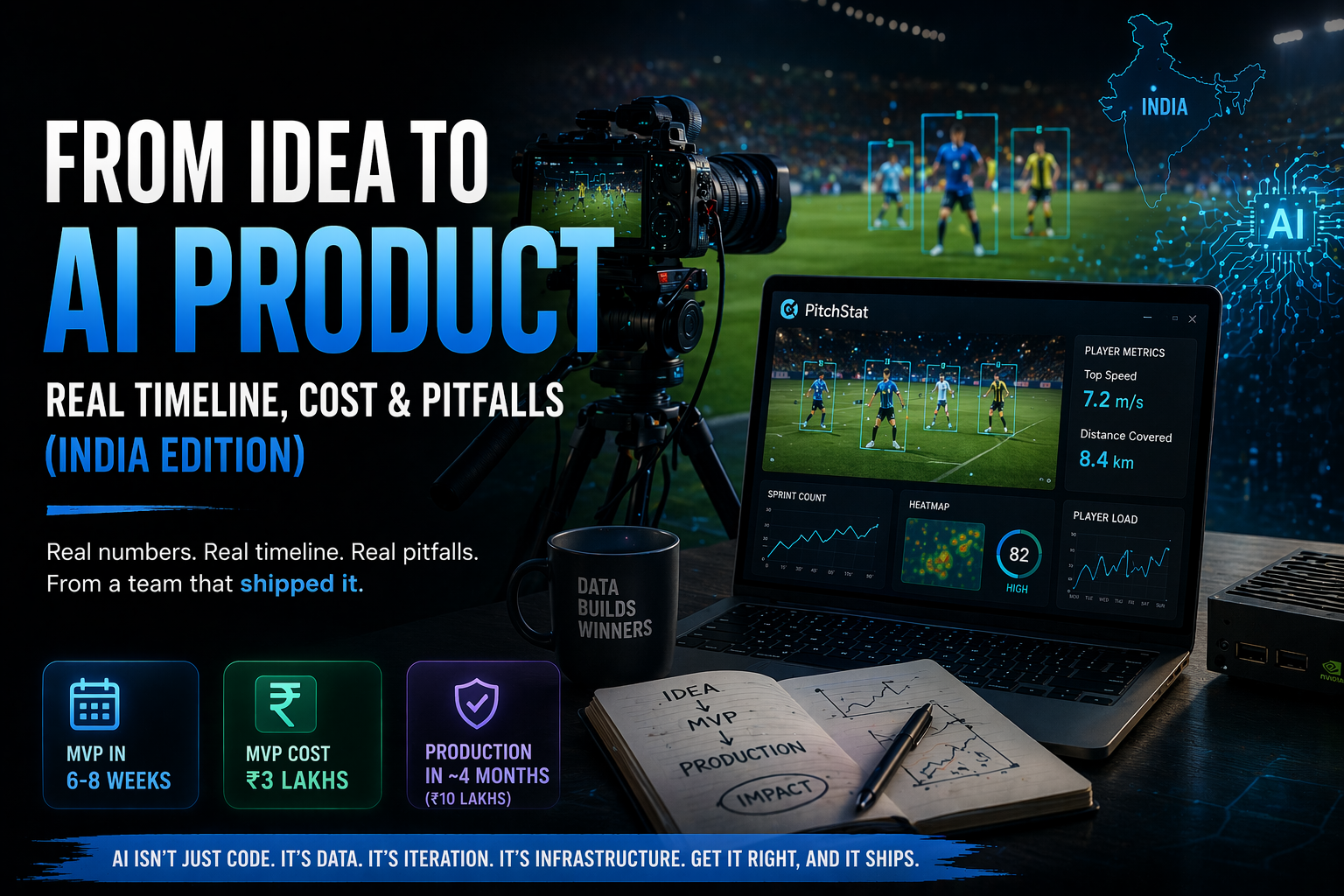
You have an idea for an AI product. Maybe it's a vision system for your factory floor, or a smart camera that counts footfall in your retail store. You've seen the demos, read the LinkedIn posts, and now you want to build it.
Here's the part nobody tells you upfront: the AI product development cost in India isn't what breaks most projects. It's the assumptions you walk in with — about timelines, about accuracy, about what "done" means. We built PitchStat, a real-time computer vision sports analytics system, from concept to production deployment. This post is the unfiltered version of what that looked like — timeline, cost, and every pitfall that tried to kill the project.
Most AI Projects Die Before They Ship
This isn't speculation. According to Gartner, roughly 85% of AI projects fail. An MIT study from 2025 found that around 95% of enterprise generative AI pilots never delivered measurable business impact. The reasons are depressingly consistent: poor data quality, unclear business value, and wildly unrealistic expectations about what AI can do on day one.
In India specifically, the gap between "we want AI" and "we understand what building AI actually requires" is massive. Non-technical founders often budget for the software build but forget about the data pipeline, the retraining cycles, and the months of tuning that follow the first deployment.
The projects that survive are the ones where the founding team understood one thing early: an AI product is not a software product with a model bolted on. It's a data product that happens to have software around it.
What the Real Timeline Looks Like: PitchStat as a Case Study
PitchStat is a computer vision system that analyses sports performance in real time — tracking motion, extracting metrics, and delivering insights that coaches and athletes actually use. Here's how the timeline broke down:
Weeks 1–2: Problem scoping and data strategy Before writing a single line of model code, we spent two weeks defining exactly what the system needed to detect, what "good enough" accuracy meant for the first version, and — critically — how we'd collect and label training data. This phase is where most projects either set themselves up for success or silently doom themselves.
Weeks 3–6: MVP model + basic pipeline Training the initial model, building the inference pipeline, and getting a working prototype that could process video input and return structured output. At this stage, accuracy was nowhere near production-grade. That's expected. The goal was to validate that the approach worked, not to ship a finished product.
Weeks 6–8: MVP delivery A functional system that stakeholders could interact with, test against real scenarios, and provide feedback on. This is your ₹3 lakh milestone — a working vision MVP that proves the concept and surfaces the real-world edge cases no amount of planning would have caught.
Months 3–4: Production hardening This is where the real work happens. Retraining on production data, handling edge cases (lighting changes, camera angles, unexpected inputs), building monitoring and alerting, integrating with the client's existing systems, and optimising for the target hardware. The budget for this phase scales based on complexity, but for a system like PitchStat, full production integration landed within ₹10 lakhs.
The total: MVP in 6–8 weeks. Production-grade in ~4 months. This timeline varies by domain and use-case complexity — a warehouse safety system is different from a sports analytics platform — but the structure is consistent.
The Real AI Product Development Cost in India
Let's put actual numbers to this, because the ranges floating around online are either absurdly low (₹50,000 chatbot quotes) or absurdly high (crores for enterprise AI). Here's what a computer vision product actually costs in India when you're working with a team that's done this before:
MVP (proof of concept to working prototype): Within ₹3 lakhs This gets you a trained model, a basic inference pipeline, and a demo-able system. It won't handle every edge case. It won't scale to thousands of concurrent users. But it will prove whether your idea works with real data.
Production integration: Within ₹10 lakhs This includes retraining, edge-case handling, hardware optimisation (if you're deploying on edge devices like Jetson), API development, dashboard or integration layer, monitoring, and initial deployment support.
These numbers are for a vision AI system. Voice AI, robotics, or multi-modal systems will have different cost profiles. But the principle holds: start with a focused MVP, validate with real data, then invest in production hardening.
For context, global estimates for AI development range from $30,000–$150,000 depending on complexity. India's cost advantage is real — strong engineering talent at significantly lower rates — but "cheaper" doesn't mean "easy." The complexity is identical. You're just paying less per hour for the people solving it.
Three Pitfalls That Kill AI Projects (We've Seen All Three)
Pitfall 1: Garbage In, Garbage Out — And Nobody Planned for "In"
The single most common failure mode. A founder walks in with a product vision, a rough timeline, and zero data strategy. They assume they can train a model on whatever data is lying around — low-resolution CCTV footage, inconsistently labelled spreadsheets, images scraped from Google.
With PitchStat, we learned this early. Sports video data has massive variance — different stadiums, lighting conditions, camera angles, jersey colours. If your training data doesn't represent the deployment environment, your model will fail in production no matter how well it performs in the lab.
The fix: Budget time and money for data collection and labelling as a first-class activity. Not an afterthought. Not something an intern does in week one. A dedicated phase with clear quality standards.
Pitfall 2: Expecting 99% Accuracy on Day 30
This is the expectation that destroys more client relationships than any technical failure. A non-technical founder sees a demo where the model performs well on cherry-picked examples and assumes that's the baseline. Then the system goes into the real world, encounters conditions the training data didn't cover, and accuracy drops to 80%.
That 80% isn't a failure. It's the starting point. Every production AI system improves through a feedback loop: deploy → collect production data → identify failure modes → retrain → redeploy. This cycle is the product. Not the first model.
The fix: Set expectations explicitly before the project starts. Define what "good enough for V1" means in measurable terms. Build a retraining pipeline from day one, not as a phase-two afterthought.
Pitfall 3: No Retraining Pipeline = A Model That Rots
This one's subtle and deadly. You ship a model that works. The client is happy. Three months pass. Performance degrades. Nobody notices until the system is producing unreliable output.
This is model drift — the real-world data distribution shifts away from what the model was trained on. In computer vision, this happens constantly: seasons change, new products appear on the shelf, people start wearing different clothing, a camera gets bumped two degrees to the left.
Industry data backs this up: IBM has documented how model accuracy can degrade within days of deployment when production data diverges from training data. A 2024 enterprise survey found that 67% of organisations running AI at scale reported at least one critical issue linked to undetected model drift.
The fix: A retraining pipeline isn't optional. It's core infrastructure. Build it into your V1 architecture and your V1 budget. Schedule regular model evaluations. Set up automated alerts when performance metrics drop below your threshold.
Build vs. Buy: A Decision Framework for Non-Technical Founders
If you're a founder without a deep technical background, you're facing a strategic choice before you write your first cheque:
| Factor | Build In-House | Work With a Specialist Team |
|---|---|---|
| Time to MVP | 4–6 months (hiring + ramp-up) | 6–8 weeks |
| Data strategy | You need to figure this out | Comes built into the process |
| Retraining pipeline | Often skipped until it's too late | Built from day one |
| Cost (first year) | ₹25–40L+ (salaries, infrastructure, trial-and-error) | ₹3–10L (depending on scope) |
| Risk | High — learning curve is steep | Lower — team has shipped before |
The honest answer: if AI is your core product and you plan to build a 50-person AI team, build in-house eventually. But for your first product, your first deployment, your first proof to the market — work with a team that's already made the mistakes. You'll move faster and spend less learning lessons that someone else has already paid for.
A Realistic Roadmap for Your First AI Product
Month 1: Problem scoping, data audit, feasibility assessment. Don't write model code. Understand your data.
Month 2: MVP development. Train initial models, build the inference pipeline, get something working end-to-end.
Month 3: Testing with real-world data. Identify edge cases. Collect feedback. Start the first retraining cycle.
Month 4: Production hardening. Optimise performance, integrate with existing systems, deploy monitoring, go live.
Months 5–6: Operate, monitor, retrain. This is where the product matures. Each retraining cycle closes the accuracy gap.
This isn't a sales pitch timeline. It's what actually happens when the project is well-scoped and the team knows what they're doing.
The One Thing That Separates Projects That Ship from Projects That Don't
It's not the model architecture. It's not the framework. It's not the budget.
It's whether the team understood, on day one, that building an AI product is an iterative data problem — not a one-shot software delivery. The founders who internalise this build products that improve every month. The ones who don't end up in the 85% that never ship.
We built PitchStat, ARIA, the Blade Inspection Rover, and smart parking systems across 7+ countries. Every single one of them followed this same pattern: scope tight, ship fast, retrain relentlessly.
If you're building something similar, Neurabit can help you deploy this in weeks, not months.
Ready to deploy?
Build your own From Idea to AI Product: Real Timeline, Cost & Pitfalls (India Edition)?
We've shipped systems like this in weeks, not months. Book a call and let's talk through your use case.
Book a Meeting