How Computer Vision Is Replacing Manual Inspection in Manufacturing
 Subham Agrawal3 April 20269 min read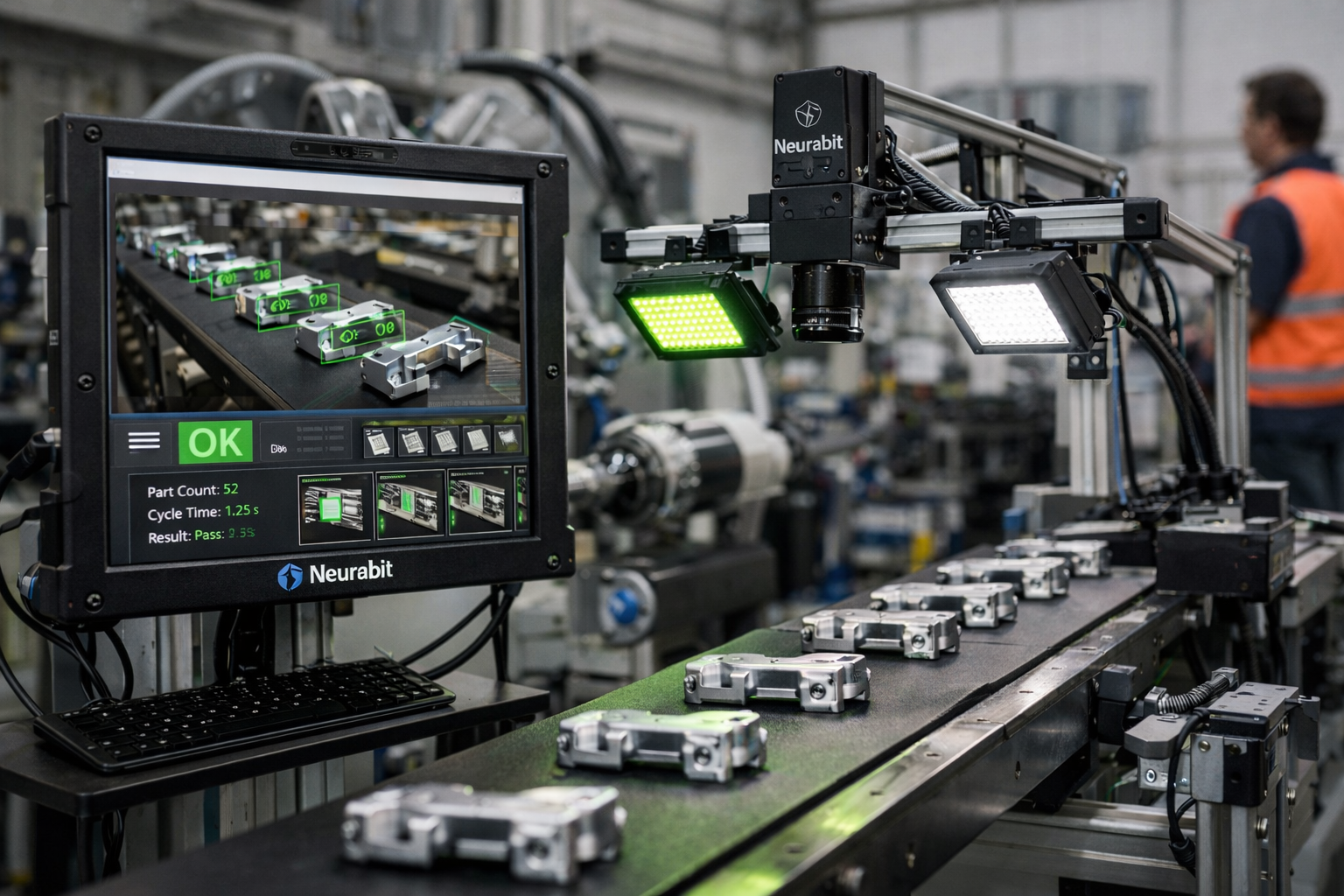
How Computer Vision Is Replacing Manual Inspection in Manufacturing
A single missed surface crack on a steel coil costs more than the inspector's monthly salary. Multiply that by three shifts, seven days a week, across a plant running 200+ tonnes per day — and you start to see why computer vision manufacturing inspection is no longer a "nice to have." It's a P&L line item.
Manual quality inspection has been the default for decades. But the math has stopped working. Fatigue-driven misses, inconsistent grading, zero traceability — these aren't edge cases. They're the baseline reality on most factory floors today. The companies pulling ahead aren't hiring more inspectors. They're deploying cameras and inference models that don't blink.
At Neurabit, we've deployed automated visual inspection systems across steel plants, automotive lines, and textile units. Here's what we've learned about what works, what doesn't, and how to think about the transition.
Why Manual Inspection Is a Broken System
The problem isn't that human inspectors are bad at their jobs. It's that the job itself is designed to fail at scale.
Fatigue and consistency decay. Studies across manufacturing verticals consistently show that inspector accuracy drops significantly after the first 20–30 minutes of continuous visual scanning. By hour six of a shift, miss rates can climb to 25–30%. A defect that gets caught at 9 AM gets waved through at 3 PM.
No traceability. When a customer returns a defective batch, manual inspection gives you nothing to trace back to. No timestamp, no image log, no correlation between the defect and the production run. You're left guessing.
Throughput bottleneck. Inspection stations become chokepoints. In steel plants, coils or billets stack up waiting for a human to sign off. In automotive, end-of-line inspection adds minutes per unit. In textiles, fabric rolls move at 30–60 metres per minute — no human can scan that reliably.
Grading inconsistency. Ask three inspectors to grade the same surface defect and you'll get three different answers. What counts as "acceptable" shifts with the person, the lighting, and whether it's the start or end of a shift. This inconsistency bleeds directly into customer complaints and rework costs.
The real cost isn't just the missed defects. It's the downstream damage: warranty claims, production rework, customer churn, and the compliance risk in regulated verticals like automotive and pharma packaging.
How Computer Vision Actually Works on the Factory Floor
Computer vision manufacturing inspection isn't about bolting a webcam to a conveyor and calling it AI. The systems that actually work in production have three layers working together.
Capture layer. Industrial cameras (area scan or line scan, depending on the application) paired with controlled lighting — typically LED bars or backlights tuned to the surface type. Steel surfaces need different lighting angles than fabric or painted auto panels. Getting this wrong is the #1 reason pilot projects fail.
Inference layer. A trained deep learning model — usually a convolutional neural network fine-tuned on your specific defect types — runs on an edge device (NVIDIA Jetson, industrial PC, or similar). The model classifies each frame or region in real-time: pass, fail, or flagged-for-review. Inference happens locally, on the line, in under 100 milliseconds.
Action layer. The system triggers a response — a reject gate, a spray marker, an alert to the shift supervisor, or a log entry in the MES/ERP. The inspection result is timestamped, geotagged to the production stage, and stored with the original image. Every decision is auditable.
What changed in the last 3–4 years to make this viable at scale? Three things: edge compute got cheap enough (a Jetson Orin Nano costs under $300), model architectures got efficient enough to run at 30+ FPS on edge hardware, and transfer learning made it possible to train production-grade models with 500–2,000 labelled images instead of 50,000.
Real Deployments: Where Computer Vision Defect Detection Delivers
Theory is cheap. Here's what automated visual inspection looks like in actual manufacturing environments.
Steel & Metals: Surface Defect Detection on Hot-Rolled Coils
In a large integrated steel plant, we deployed a multi-camera inspection system across the hot strip mill's finishing line. The system scans coil surfaces at line speed (up to 15 m/s) using high-resolution line-scan cameras with custom LED strobing.
The model detects seven defect classes — scratches, scale pits, edge cracks, rolled-in scale, oil spots, rust patches, and lamination defects — with a detection accuracy above 96%. Previously, two inspectors per shift eyeballed coils and logged defects on paper. The miss rate was estimated at 18–22%.
Outcome: Defect escape rate dropped below 3%. Rework and customer rejection costs fell by roughly 40% in the first six months. Every coil now has a digital inspection certificate linked to its production ID.
Automotive: Weld and Surface Inspection on Body Panels
On an automotive body-in-white line, we deployed area-scan cameras at three stations — post-welding, post-painting, and final assembly. The weld inspection system checks for incomplete welds, spatter, and misalignment. The paint inspection catches orange peel, runs, and inclusions under structured lighting.
The edge AI system processes each panel in under 200 milliseconds and flags anomalies to the station operator's HMI screen in real time. Panels with critical defects trigger an automatic divert to the rework bay.
Outcome: End-of-line rework dropped by 35%. The plant eliminated one full-time inspector role per shift (redeployed to process engineering). Defect data now feeds back into welding robot parameter tuning — closing the loop between inspection and production.
Textiles: Fabric Defect Detection on Weaving Looms
Textile mills run fabric at 40–60 metres per minute. Human inspectors catch maybe 60% of defects — holes, broken threads, stains, pattern mismatches — and even those catches are inconsistent across shifts.
We deployed line-scan cameras directly above the loom output, feeding into a Jetson-based inference unit per loom. The model flags defects and maps their exact position on the roll. The quality team reviews flagged sections on a dashboard instead of manually scanning entire rolls on a light table.
Outcome: Defect detection rate jumped from ~60% to 94%. Inspection time per roll dropped by 70%. The mill reduced its grade-B reclassification rate by half, directly improving margins on export orders.
Edge AI vs. Cloud AI for Manufacturing Inspection
One of the first decisions you'll face: should inference happen on the edge (at the camera/line) or in the cloud?
For real-time manufacturing inspection, this isn't a close call.
| Factor | Edge AI | Cloud AI |
|---|---|---|
| Latency | <100ms (real-time reject/pass) | 500ms–2s (network + processing) |
| Reliability | Works offline, no dependency on connectivity | Fails if network drops — unacceptable on a production line |
| Data privacy | Images stay on-premises | Images transit to external servers — compliance risk |
| Bandwidth | Processes locally, sends only metadata/alerts | Streams high-res video — expensive and impractical at scale |
| Recurring cost | One-time hardware + updates | Ongoing compute charges that scale with throughput |
| Scalability | Add a device per line/station | Scales compute, but bandwidth and latency don't improve |
Our recommendation: Edge-first for any inspection that triggers a real-time action (reject, divert, alert). Cloud for model retraining, historical analytics, and cross-plant benchmarking. This hybrid architecture gives you the speed of edge with the intelligence of cloud — without the fragility of depending on either alone.
This is why Neurabit's CV-as-a-service approach deploys inference at the edge by default. The cloud layer handles dashboards, retraining pipelines, and fleet management across sites.
How to Deploy AI Quality Inspection: A Practical Roadmap
If you're evaluating computer vision quality control for your plant, here's the phased approach that actually works — based on what we've shipped, not what looks good in a pitch deck.
Phase 1: Audit & Data Collection (2–3 weeks)
Walk the line. Identify the inspection points with the highest defect escape rate or the biggest throughput bottleneck. Install temporary cameras to capture representative samples across shifts, lighting conditions, and product variants. You need 1,000–2,000 images covering your defect taxonomy to start.
Common pitfall: Starting with the hardest problem. Don't. Pick the inspection point where the defect is visually obvious and the business impact is clear. Win there first.
Phase 2: Model Training & Validation (3–4 weeks)
Label defect images with your quality team (they know the taxonomy better than any data scientist). Train a baseline model, validate against held-out samples, and iterate. Target 90%+ detection accuracy before moving to line trials.
Common pitfall: Chasing 99% accuracy in the lab. Production conditions — vibration, dust, lighting variation — will knock 3–5% off your lab numbers. Optimize for robustness, not perfection.
Phase 3: Line Pilot (2–3 weeks)
Deploy on one line or one station. Run in "shadow mode" first — the system logs detections but doesn't trigger any actions. Compare its calls against human inspectors for two weeks. This builds trust with the operations team and exposes edge cases.
Common pitfall: Skipping shadow mode. If the system triggers a false reject on day one, the floor team will never trust it. Earn credibility before going live.
Phase 4: Production Rollout & Scaling (Ongoing)
Go live with automated actions (reject gates, alerts, logging). Monitor model drift monthly — production changes, new material batches, and seasonal variations will shift defect patterns. Plan for quarterly retraining cycles.
Total timeline for a single-line deployment: 8–12 weeks. Cost depends heavily on camera requirements and integration complexity, but a single-station edge AI inspection system typically runs ₹8–15 lakhs all-in for hardware, software, installation, and initial training.
The Inspection Floor Doesn't Need More Eyes — It Needs Better Ones
Manual inspection was the best tool available for fifty years. It isn't anymore. The gap between what a camera-and-model system catches and what a human inspector catches isn't marginal — it's structural. And it compounds with every shift, every line, every plant.
Computer vision manufacturing inspection isn't about replacing people. It's about redeploying them from a task humans are biologically bad at (staring at surfaces for eight hours) to work that actually needs human judgment — process optimization, root cause analysis, supplier quality management.
The plants that figure this out first don't just reduce defect rates. They build a data asset — every defect, every image, every production run — that makes their quality system smarter over time. That compounding advantage is the real moat.
If you're building something similar, Neurabit can help you deploy this in weeks, not months.
Ready to deploy?
Build your own How Computer Vision Is Replacing Manual Inspection in Manufacturing?
We've shipped systems like this in weeks, not months. Book a call and let's talk through your use case.
Book a Meeting